What Is AI, Really? Seven Ideas from David Weinberger
Philosopher David Weinberger, author of Beautiful Particulars, talks with DFC CEO Mike Keene about what AI actually is. Seven ideas from the conversation and what each one means for design firms.
Our first AI Readiness Field Note opened a series that looks past AI as a tool. Part of that work is asking what AI actually is, a question David Weinberger has spent years thinking about.
David is a philosopher and longtime affiliate of Harvard’s Berkman Klein Center who spent years embedded with machine learning teams as a writer in residence. He co-wrote The Cluetrain Manifesto and wrote Everyday Chaos. His new book, Beautiful Particulars, is out from MIT Press this month. Mike Keene, DFC CEO, sat down with him to talk about AI not as a tool to adopt, but as something that is changing how we understand knowledge, creativity, and ourselves.
The conversation moves quickly, and David’s ideas build on each other. This guide covers seven of them. Each entry gives the idea in short, how David illustrates it in the video, and why it matters for firms. Watch the full conversation first, or use the timestamps to jump in.
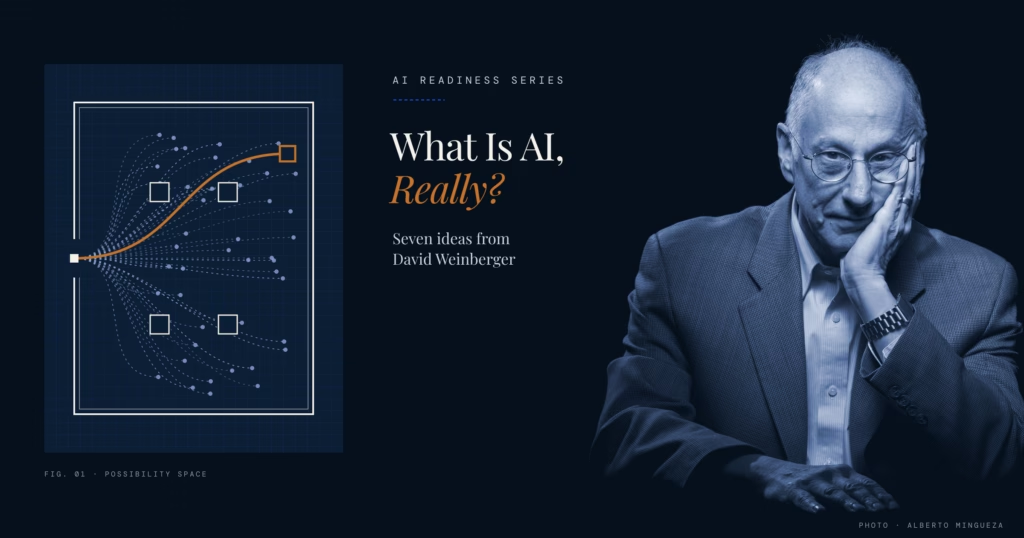
Every situation has a range of things that could happen next. Some are likely, some are surprising. A possibility space is that range, ranked by likelihood. AI works by learning it from data.
In the video
When you listen to Bach, you sense where the music might go next. Bach wrote within that space of possibilities, and we listen within it. AI learns the same map by studying everything Bach wrote: “a mathematical map of the likelihood of all these possibilities.”
Why it matters
AI is very good at finding the likely answer. Much of design depends on knowing when the likely answer is the right one, and when it isn’t. That judgment belongs to the people and the firm, not the tool.
Creativity isn’t a spark from nowhere. It’s a move within the possibility space that nobody saw coming, and that turns out to be exactly right.
In the video
A jazz musician friend of David’s laughs when a bandmate takes a “promising left turn”: surprising, but right. David finds that rightness explains creativity better than “the idea of a creative spark.” He also notes that AI’s output can surprise us the same way.
Why it matters
If creativity is a move rather than a mystery, firms can talk about it, teach it, and recognize it. And if AI can also produce surprising options, the human contribution shifts toward knowing which surprise is right.
People judge with their bodies and with what they care about. AI has neither.
In the video
We know a joke works because we laugh. We sense a design is off before we can say why. AI “can’t tell that something that passes those tests just doesn’t feel right,” and nothing matters to it: you can unplug it without it minding. That’s why David prefers “bringing AI into a human loop” to keeping a human in AI’s loop.
Why it matters
When a building is wrong, people get hurt. The feel for when something is off comes from years of practice and from caring about the outcome. If AI takes over the work that used to train people, firms have to find another way to build that judgment.
People tend to describe themselves using their most advanced technology. AI is next.
In the video
Clocks gave us a “clockwork universe.” Computers made everything look like data and process, and companies reorganized to match. David expects AI to reshape how we see ourselves again, and reminds us we are only “two seconds” into this era in civilizational time.
Why it matters
Firms will be tempted to restructure around how AI works. Before they do, it’s worth asking which parts of that picture describe people and practice well, and which are just the latest metaphor.
Real decisions depend on many factors at once. AI can weigh far more of them than we can, but the complexity was always there.
In the video
Pricing a house depends on bedrooms, schools, the garage, moths, even whether you liked the neighbors. “This is not a feature of machine learning, it’s actually a feature of life.” Fairness works the same way: easy to define, hard to apply, which makes it “a conversation” rather than a yes or no.
Why it matters
Firms often reduce success to a single number. More dimensions mean real trade-offs, and leaders who name them on purpose tend to decide better than those who let one metric decide for them.
This is not a feature of machine learning, it’s actually a feature of life.
A particular is a specific person or thing, as opposed to the category it belongs to. Categories are useful, but no person or thing is just its category. What makes something valuable is often what makes it different.
In the video
David says everything he has written comes back to “the value of the particular thing.” A hammer, a pen, a pancake each mean something specific to us. We love our children for what is particular to them.
Why it matters
Firms describe their clients, their projects, and themselves by type. AI works well with types and averages. The value a firm adds may live in the particulars, the specific details of a client, site, or project that the category leaves out.
Much of what we know, we learned by doing and hearing, not from rules or definitions. AI learns the same way, without the understanding.
In the video
Early AI tried to write rules for everything and failed. David’s granddaughter learned the word “yet” without anyone defining it. Most of us can’t define “skating,” but “I know it when I see it.” AI learns words from context too, “except for the understanding part.”
Why it matters
Experience in a firm works this way. It’s learned on the job and rarely written down. Firms will need to decide which work can run on rules and which depends on judgment that only comes from doing.
What comes next
David doesn’t offer conclusions, and neither do we. As Mike put it in closing, “If today’s questions followed you out of the room, that’s the point.”
A companion piece gathers the stories David uses to explain these ideas, from Bach to fudgsicles, into a holiday menu for your table. And a question to take back to your firm: which of these seven ideas changes how you think about your work? And what is your own analogy for what AI is, or for what creativity means now?