
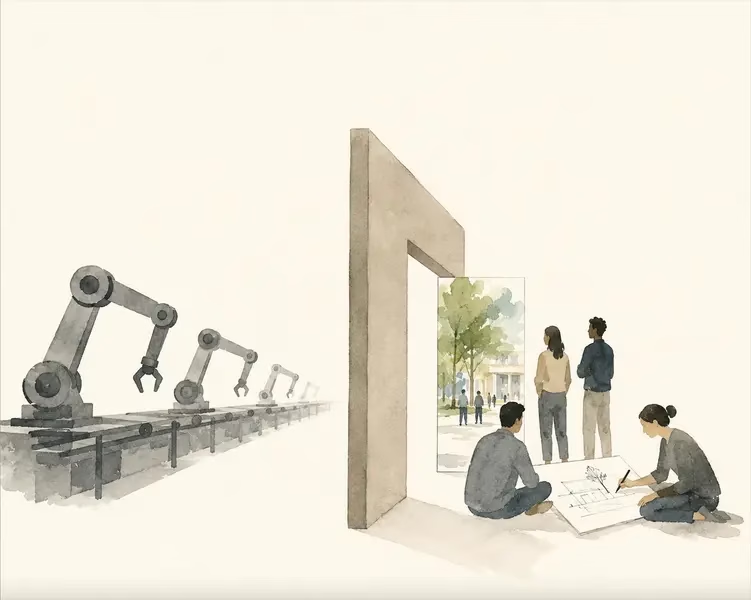
We live in a time of confusion.
As truth is increasingly treated as subjective, the notion of a shared or universal truth has eroded. Without common reference points, people act according to their own belief systems. Personal values, social norms, political ideologies, and business ethics shift and collide.
With the emergence of AI, this landscape becomes even more complex. Is AI an extension of humanity, a tool that amplifies human creativity? Or is it a force that threatens to replace human agency? More likely, it exists somewhere in between, and its role has yet to be clearly defined.
As our beliefs shift, they have consequential impact on the world we build. Design has never been neutral or objective. It is an expression of what we choose to value. In an age marked by conflicting values, design becomes inherently contentious.
The Confusion of Language in the Built Environment
In the built environment, this confusion runs deeper still. We speak the same words but mean different things.
“Sustainability” to one firm is an existential commitment; to another is a marketing imperative.
“Innovation” is either a promise or a risk, depending on who you ask.
“Value” means design excellence to some and cost savings to others.
“Leadership” can describe a title, a behavior, or an aspiration, often in the same conversation.
This brings to mind the story of the Tower of Babel. Humanity once shared a single language. When that common speech fractured, collaboration ceased. Whether understood as history or metaphor, the lesson holds.
Shared language enables collaboration. Confused language obstructs it.
Before we can build together, we must learn to speak together.
Returning to Fundamental Questions
In this moment of flux, Design Futures Council sets out on its 2026 inquiry to explore a series of fundamental questions intended to return us to what actually matters in humanity and design.
There will never be a single answer, and that is not the point. The point is to ask better questions and follow where they lead. Individuals will arrive at different conclusions. We welcome that multiplicity. We do not seek to impose certainty.
Certainty, in this moment, would be a lie.
We believe these are the consequential conversations our industry needs to have right now.
They are a foundation, not a finished building. We invite you to help us construct what comes next.
The Questions We Must Ask
Our inquiry begins at the most fundamental level. Before we can ask what design should do, we must ask what we are. The first question, what is essential?, is not about importance in the everyday sense of the word. It is about being itself: not what we do or what we produce, but what we are without which we would no longer be human at all.
Every other question depends on that foundation. Questions of authorship, intelligence, and relevance only become meaningful once we have genuinely grappled with what it means to be human.
From there, we extend into consequence. How do we act ethically in the absence of certainty? What is the responsibility of those who shape the physical world? How do we design for generations we will never meet? These are not abstract provocations. They are what follows when you take human essence seriously and trace it into practice.
These questions are not a comprehensive map. They are starting points. The themes we explore and the questions we ask will continue to evolve as the world changes and new challenges arise.
How We Approach the Questions: Clarity Before Exploration
Clarity of language is where we begin.
In a profession that rewards momentum, the discipline of definition is an act of leadership. For this reason, the first step in each piece of our work will be to clarify language by defining key terms and establishing a common speech.
Only then will we engage the deeper questions and their implications. In doing so, we will examine broad themes alongside the real-world contexts in which they take shape.
Join the Conversation
We begin here, but we don’t intend to arrive alone. We are extending an open invitation: bring your perspective, your experience, your questions and doubts. This inquiry belongs to all of us.
The built environment will be shaped by those willing to ask harder questions. That work starts here. Join us.
What fundamental questions are you thinking about? Tell us below and stay tuned for upcoming deep-dives exploring a range of themes.
Next: we ask what is essential.